
62. The Web
The story of a new white separatist community in Arkansas needs to be told in the context of a larger history of domestic extremism

In this era of strange moments, I find myself also living inside a personally strange moment. This summer marks my 22nd year working in journalism and my 12th as a freelancer. I’ve accomplished more than I could have ever imagined, particularly since I went out on my own, and the list of things I want to write about is long and could keep me busy for years.
And yet it is more difficult than ever to get work. Most of the magazines I wrote for before I started publishing books, in 2022, are gone. Rates at the outlets that are left have plummeted. Money is hard to come by in this profession, respect even harder.
If you are here, you know the journalism I make. You know I am committed to doing so as independently as possible. You know the success rate I have: telling the story of a man freed from a 25-year prison sentence; the books I’ve published that illuminate the real story behind tragic events that could have been lost to sensational true crime coverage; the interviews I’ve gotten with people who said they’d never talk to media.
If you like what I do, it’s a great moment to get a paid subscription to this newsletter because I cannot guarantee to you that the outlets I work for now will prioritize funding investigative journalism. Everything in journalism is changing rapidly.
Thank you for your support. And, as always, if you have suggestions for me on more of what you want to see in this newsletter, please let me know. I’m always open to your feedback.
Now, for today’s dispatch:
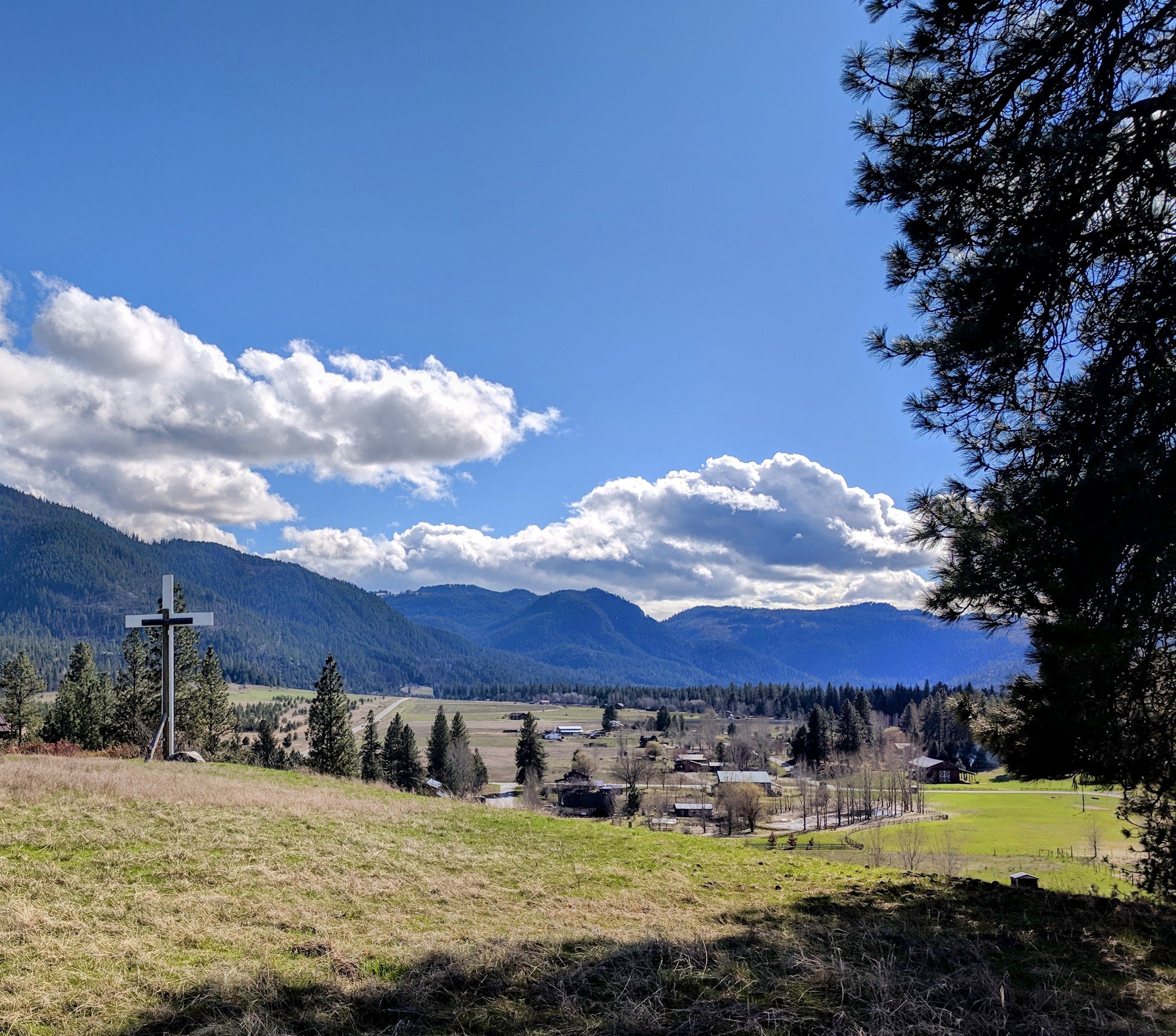
In June, reporter Hannah Feuer, of The Forward, broke the story that right now, sixty years after the United States outlawed racial and religious discrimination in housing, a group of people is building a whites-only community in Northeastern Arkansas, in the Ozarks. It’s called Return to the Land.
Here’s an excerpt from the article:
Return to the Land, a white supremacist group started in 2023, owns 160 acres in northeast Arkansas, according to the group’s website. Jews and non-whites are explicitly banned from membership. Prospective residents must verify their “ancestral heritage” in a written application and interview before becoming paying members and residing in the off-grid settlement, according to the group’s Substack.1
The organization hopes to replicate its whites-only settlements across the country, with the stated aim of “trying to put land back under the control of Europeans.”
Sky News also did a short documentary on the project.
Appropriately, the Internet blew up over a whites-only community emerging in today’s deeply divided political landscape.
This week, David Gilbert of Wired provided detail into Return to the Land’s application, which is required of anyone who wants to live there to fill out. Gilbert writes:
The application form for Return to the Land asks potential members to outline their ancestry and also respond to a range of questions about their social and cultural viewpoints, including whether they support foreign immigration, “transgenderism,” Covid-19 vaccines, and segregation. It also asks: “How often do you think about the Roman empire?” with answers ranging from “every day, at least once” to “a few times a week, probably” and “never.”
Gilbert writes that there’s more to the place than the bucolic setting Return to the Land promises:
Though the organization claims that Return to the Land is nothing more than a peaceful settlement of like-minded people, the online histories of the group’s leaders tell a different story. Members have espoused virulently racist and antisemitic views and repeatedly praised Adolf Hitler and the Nazi party. One of the leaders says he is currently under criminal investigation in Ecuador. Orwoll himself has spoken about the coming of a second Hitler and praised KKK leader David Duke. He is also closely aligned to an international network of far-right influencers, extremists, and white supremacists, including Thomas Sewell, a neo-Nazi living in Australia who was the founder of a group that influenced the Christchurch, New Zealand, shooter.
I’d like to add some history to this conversation about white separatist communities. In the past 40 years, some of America’s most well-known domestic terrorists spent time in, were given refuge by, or sought fellowship with white separatist communities. In particular, one community in the very same mountain range as Return to the Land has been a focal point of work that I’ve done.
In 2020, I hosted and co-wrote the podcast Two Minutes Past Nine for the BBC, about the 25th anniversary of the Oklahoma City Bombing, in which 26-year-old Army veteran Timothy McVeigh killed 168 people and injured 684 with his homemade truck bomb.
As a part of that reporting, I got particularly obsessed with trying to answer a question that better reporters than I have been trying to get an answer to for three decades: why did McVeigh make a phone call to a white-separatist community on the Oklahoma/Arkansas border the morning of his bombing?
That place is called Elohim City. It is also in the Ozarks, just on the Oklahoma side of the border. And in 1996, Spokesman-Review reporter Bill Morlin — who became a close friend of mine in the last few years of his life — was wondering the same thing. That year, the Spokane-based newspaper sent him and a photographer to interview people at Elohim City2, which had myriad connections to the Inland Northwest and described itself in many of the same terms that Return to the Land does today.
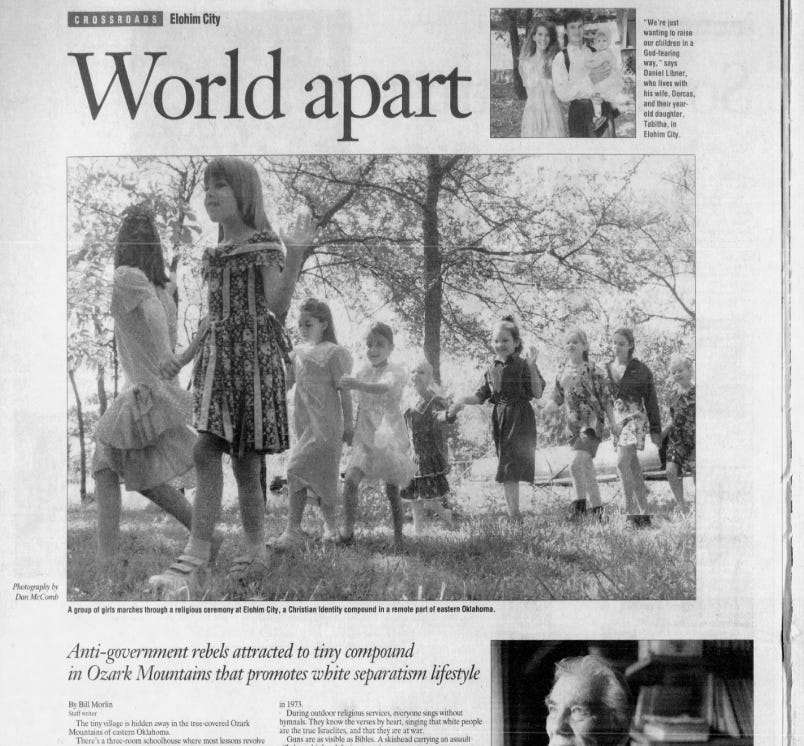
In an article called “War Within, World Apart: Anti-government rebels attracted to tiny compound in Ozark Mountains that promotes white separatism lifestyle,” Morlin wrote: “Elohim City — loosely translated to mean city of God in Hebrew — is a Christian Identity community where residents promote white separatism as a religion and a way of life.” The white separatist community had attracted people from an Arkansas paramilitary compound called The Covenant, The Sword & The Arm of the Lord (which had, itself, planned to bomb Oklahoma City in 1983, and had taken in members of The Order.) Elohim City had been a meeting spot for the Aryan Republican Army.
Robert Millar, the group’s founder and spiritual leader, told Morlin “his followers are the targets of ‘a Zionist plot.’”
On April 19, 1995, the day of the Oklahoma City Bombing, McVeigh phoned the compound.3 Twelve hours later after McVeigh’s bomb went off, one of Millar’s Elohim City followers, Richard Wayne Snell4, was executed in Arkansas. Snell had been sentenced to die after he was convicted of murdering a pawn shop owner he thought was Jewish, and a state trooper.
On Morlin’s visit, Millar couldn’t — or wouldn’t — tell him why McVeigh made that call, who he spoke to or if he spoke to anyone.
The connections weren’t clear, but they were there. Two years later, in 1998, Elohim City came up again after the Stevens County, Washington-raised Kehoe Brothers were arrested after robbing and murdering their way across the Midwest. They, too, had sought refuge at the white separatist community.
During our reporting of Two Minutes Past Nine, producer Georgia Catt and I spoke to Kerry Noble, who had been an elder in The Covenant, The Sword & The Arm of the Lord.5 He told us how in the mid-1990s, CSA had connections with other white separatist communities around the country. It was a network. A web in which they all communicated and traveled between.
By 2020, Millar was dead, and his son David was at the helm of Elohim City. I interviewed him, but he asked Georgia and I not to record it. He was explicit with us that their beliefs had not changed in the 25 years since the bombing. They still practiced Christian Identity. “The Bible is really clear that God did not approve of the interracial marriages,” Millar told us. “We don’t. We want to avoid that.”
According to Gilbert, the president of Return to the Land posted a video to X saying now is good of a time as any to create a whites-only community. “Right now we have the most favorable judiciary,” he said. “We have the most favorable cultural climate and administration that we're going to get.”
He’s right. Ideas McVeigh espoused are now coming straight from the White House. The very anti-government militiamen that he would have supported, who stormed the capitol on January 6, 2021, have been pardoned by the President. Trump’s second round in the White House has been marked by mass deportations, but rollbacks of DEI policies.
If history is a good teacher — and I think it is — it’s reasonable to believe that Return to the Land is a part of a larger network. Listen to the way the women in the Sky News video, in particular, talk. This is a “movement.” They have plans to expand. A web of Elohim Cities, and Marble Community Fellowships, and Hayden Lake compounds. Places where children are taught a doctrine of racial supremacy, or fear that whites are being replaced. There is no nonviolent version of the ideas they’re talking about.
Considering Return to the Land’s connections with extremist groups and affection for Hitler, isn’t it reasonable to assume it would also give safe haven to violent people? But journalists don’t assume. They ask that directly. And I’m wondering if the journalists who have written about this place have asked, or if they’re not asking because — given the landscape — violent extremists really don’t need to hide anymore?
I’m extremely disturbed to share Substack with any white supremacists, just like I’ve been extremely disturbed to share any corner of Twitter, YouTube, Instagram, Facebook or any online platform with hateful people. Why does hate get to have so many spaces?
The budgets (and freedom) journalists used to have!
A 2006 Chicago Tribune article alleged that was not the first call McVeigh made to Elohim City, but one of several in the weeks prior to the bombing.
More Northwest extremist ties: Snell was a part of the Fort Smith Trial, in which he was accused of seditious conspiracy and plotting to overthrow the federal government alongside several Northwest racist codefendants, including Aryan Nations leader and Order members Richard Scutari, Bruce Pierce and David Lane.
By 2020, Noble had voted for Obama, so you can say he was pretty far out of the movement by then.
This post is everything I love about your work, Leah.
So grateful for the work you do.