
67. Hypocrisy
On the whiplash of this chaotic moment

There have been a few moments in the last decade when work or life got to me and I fled to the woods, or the desert, or the coast, to cleanse my mind, only to have the news follow. When the plot to kidnap Michigan Governor Gretchen Whitmer became news, I was near the ocean. I processed the Dobbs decision by silently staring into a campfire while backpacking in Central Oregon, my anger a scream in my brain despite all that peace and quiet.
This weekend, I was with two friends on a self-guided writing retreat along the Washington coastline when news broke that an ICU nurse named Alex Pretti was murdered by federal agents in Minneapolis. I saw the video, then did the thing where I reckoned with all the opposing realities of the modern world: protesters getting shot on the streets, the song of the ocean calling out my window.
How do we live in a world of so much beauty and violence? And what are we supposed to do to change that? I don’t have an answer. BUT, I do have an archive of reporting I’ve done on the far-right in America that helps me have better clarity on how to move forward.
You know now how the White House characterized the killings of Renee Good and Pretti: Homeland Security Secretary Kristi Noem said Good was a domestic terrorist who used her car as a weapon, and the ICE agent who killed her was simply acting in self-defense. Video proves that claim is about as real as Noem’s face. Noem then said Pretti was a domestic terrorist who brandished a gun against federal agents. Again, video shows the opposite: those agents took Pretti’s gun before executing him.
David Neiwert — longtime western journalist, chronicler of the far-right and author — explained over on his Substack that what we’re seeing is real-time revisionism: “When the Trump administration heatedly declares the citizen resistance to their attempt to invade a liberal urban center with a lethal army that causally executes their neighbors to be a kind of ‘domestic terrorism,’ and labels the street activists ‘insurrectionists,’ there’s really a simple underlying reason,” he writes. “That’s what THEY are doing.”
We are living in an era of outright hypocrisy.1 People in power say one thing, but do another. Supporters of the President say certain things, then do the opposite.2 I see a lot of cable news hosts and people on the Internet struggling with such whiplash — look at what hypocrites these people are! Absolutely. Outraging — yes. If you have any kind of moral code, it can be difficult to truly reckon with the fact that other people do not live by the same standards as you.
As I’ve reported on the far-right in America, there have been moments when I feel like I’m taking a long college course called Hypocrisy 101. I’ve learned to weigh people’s words against their actions, which usually reveal their true motivations.
Like many reporters in the Pacific Northwest, I got a hypocrisy lesson by interviewing Joey Gibson, the leader of Patriot Prayer, then documenting the rallies his group organized around the region to troll leftists and provoke confrontations. Often, Gibson would decry racism and racists in speeches and to reporters.3 Yet, his rallies were havens for racists. Racists seem to really love being around him.
If you were wanting to be extra, extra clear on this point that you are not racist, wouldn’t you get exhausted by so many racists wanting to hang out with you? Wouldn’t you eventually question why you’re creating an ever-growing space for racists to be racist?
Now that President Trump is in the second year of his second term, ICE is terrifying the country after he successfully implanted the idea that immigrants are streaming over the borders into the minds of American voters. Neiwert’s book Age of Insurrection provides insight:
When most of us hear the term “authoritarianism” and picture its operations in our minds, we usually do so in the context of the leaders throughout history who have headed up authoritarian regimes — everyone from Napoleon to Hitler and Stalin to any number of petty banana-republic dictators. But that’s not what makes authoritarianism work — or at least not the whole story. No authoritarian regime has ever existed without a substantial portion of the population it rules actively supporting and preferring it. They all have large armies of followers who sustain them in power.
So to understand authoritarianism, it’s essential first to understand those followers, because they not only keep those figures in power, their version of reality takes on such a life of its own that they often wind up controlling the leading figure. There are distinctive personality types that are attracted to and support authoritarianism and understanding how they think helps us understand how and why they comprise the real threat to democracy itself.
Neiwert is clear to say that authoritarian personalities are not the sole territory of the political right. The left has them, too.
… People’s authoritarian tendencies increase the more fearful they are. Identifying a threat and forming a focus on it are essential to shaping these personalities. This is why fearmongering — whether over Islamist radicals and terrorism after the 9/11 attacks or over the border crossing migrants or “Antifa” and Black Lives Matter — has been an essential component of Republican appeals for a generation and served as the centerpiece of Trump’s ascension to the presidency and his tenure. Spreading fear is a surefire method of inducing an authoritarian response in the general public.
On this topic of immigration — something Richard Butler preached about from the pulpit at his Aryan Nations compound — Trump successfully infused a key far-right fear into American life. His rise to power is the collective ejaculate of generations of people who were horny for hate and wanted to rule America by fear. They got what they wanted: now federal agents are storming into people’s homes, kidnapping children and killing people because Trump effectively spoon-fed fear into the mouths of American voters alongside promises about the prices of eggs and not getting into wars.
Over the decades, the far-right anti-government movement has assembled a system of martyrs — people who’ve been killed by the government — and yet, despite this, we didn’t hear a lot of outcry when ICE killed eight people this month.

Look to 1992, when federal agents swarmed the remote North Idaho cabin of Randy Weaver. Weaver, who frequented the Aryan Nations compound, moved his family to the mountains over fears of the federal government. Eventually, he sold an illegal sawed-off shotgun to an undercover agent, and later refused to appear in court to face charges over it.4 But because Weaver had been so vocal that he would be violent if the feds came for him, for 18 months agents sneakily surveilled him and his family, fearful of what could happen if they served him.5
That August, bullets flew. The details can’t be truly known because a federal agent was killed in some kind of confrontation with Weaver’s teenaged son, Sam, who was, somehow, shot in the back. After killing Weaver’s son, another federal agent with a sniper rifle took aim at Weaver, grazing the man’s arm, and instead hitting his wife, Vicki, in the head. She was holding their baby when she was killed.
Ruby Ridge was a fiasco, a tragedy, a complete botch job. Understandably, Vicki and Sam Weaver became martyrs in the anti-government movement and beyond.
And yet, in the case of Renee Good — another mother shot in the head by a federal agent — the outcry is not resounding among the people who would consider the Weavers martyrs. Why is that? Hypocrisy be our guide: the Weavers were white; Good was a protester wanting to protect communities of color from ICE.
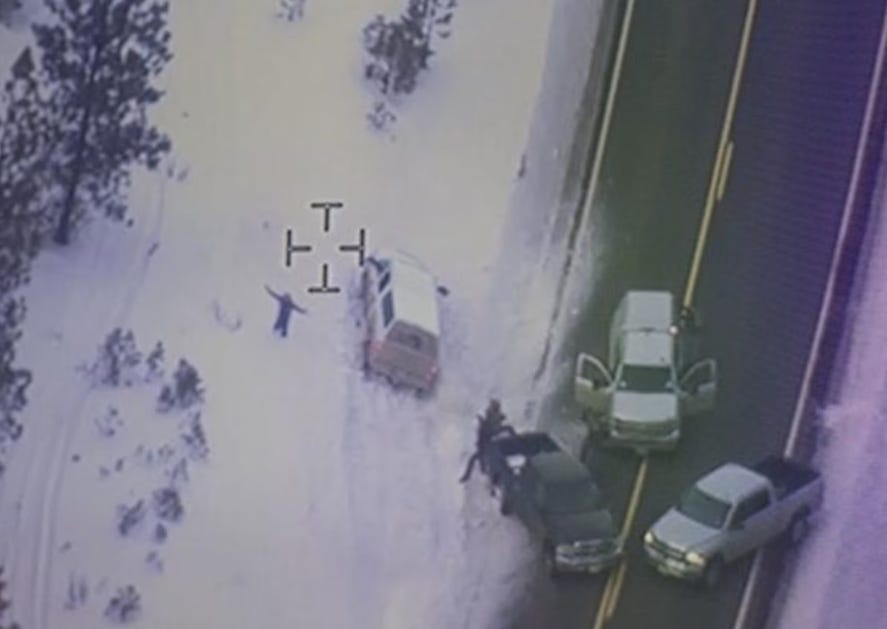
Another terrible and notable moment of outcry over the killing of a civilian by federal agents occurred almost exactly a decade ago in the winter of 2016. A rancher from Arizona named Robert “Lavoy” Finicum was shot and killed by Oregon State Police. Finicum was one of the key occupiers of the Malheur National Wildlife Refuge, who protested ownership of the land by the federal government by seizing the property for 41 days.6
Finicum fled police, who had pulled him over on a rural road. As he sped away, Finicum swerved to avoid a police roadblock, narrowly avoiding an officer on the side of the road before crashing into a snowbank. I describe what happened in this piece.
In Finicum’s case, a new martyr story was told. People said the account the government gave was a lie: that Finicum would never carry a gun in his coat pocket, that it must have been planted on his dead body. They said he wasn’t reaching for anything, that his hands were up, even though video shows his hands go up and down as he yells for the officers to shoot him.
What happened to Finicum is awful. I have a lot of feelings about the use of any fatal violence by law enforcement against people, and yet in this situation, I can feel sick that he died, and also understand how this was the outcome. His family continues to mourn.
Alex Pretti had a gun, too. But his situation couldn’t be more different: videos of his killing show that it was not a gun in his hands when agents dogpiled him, but a cell phone. He was filming them. They tackled him, took his gun, then executed him.
Here, again, hypocrisy. The people who see martyrdom in Finicum do not in Pretti. Finicum was a white rancher in a cowboy hat who seized federal property; Pretti was a man protesting ICE on behalf of immigrants while exercising his First and Second Amendment rights.
Neiwert provides an answer in his book to why we’re seeing people say that Americans shouldn’t protest law enforcement, that Pretti got himself shot for behaving badly, for having a gun in the first place — all things that fall apart if you look at the examples I gave above.7 This is the rush to push an authoritarian mindset down your throat:
Right-wing personalities are built around three behavioral and attitudinal clusters:
First: Authoritarian submission. This is the eager adherence to edicts, rulings, and opinions of the authorities and leaders who are deemed legitimate, built around the belief that a civil, ordered and secure society requires such submission
Next: Authoritarian aggression — the physical, verbal and social aggression displayed toward anyone or any trend that runs counter to those authorities, or in the case of leadership, is deemed illegitimate.
Finally: Conventionalism, the adamant embrace of what is perceived as the social norm and the ‘real’ national identity, and the belief that one’s immediate cultural community and self reflect that ‘real’ identity.
Understanding hypocrisy helps me process what I’m seeing while I’m yelling at the videos and crying uncontrollably, and suddenly, over this mess we’re in.
It is rage-making to see how the very people who crow about American freedom aren’t out there in the streets of Minneapolis, aren’t raging at elected Republicans for rubber-stamping all of this. People who wear the flag and make the Constitution their personality, who have We, the People tattooed on their arms, or emblazoned on trucks, are not in the streets of Minneapolis because these are authoritarian personalities, deferential to their guy in the White House that they trust.
Hypocrites, like authoritarian minds, are not the sole property of the right-wing. Right now, to believe Democrats can do absolutely nothing while they say well I had to vote to fund ICE is hypocrisy.
This month I’ve wondered how much longer we’re willing to live in our gray collective winter — this political chaos that has been the last ten years. How long will we really let ourselves be told that everything this one man in the White House does is immovable? There are non-negotiable things in this world, but being by the ocean reminded me that none are the laws of men. If a hurricane is on course to flatten us, we cannot stop it, only move out of the way. If the plates underneath our feet come to collide, it will obliterate our world if we aren’t prepared. These are real laws and there is no court in which we can quibble over them.
It is a lie to believe that people cannot be stopped, that ICE can’t be stopped, that our world is forever bent because of this time and nothing can change. I don’t believe that. To believe that means the fear is working on you. And maybe you just need someone to tell you there’s more we can do, that you’re not in this alone.
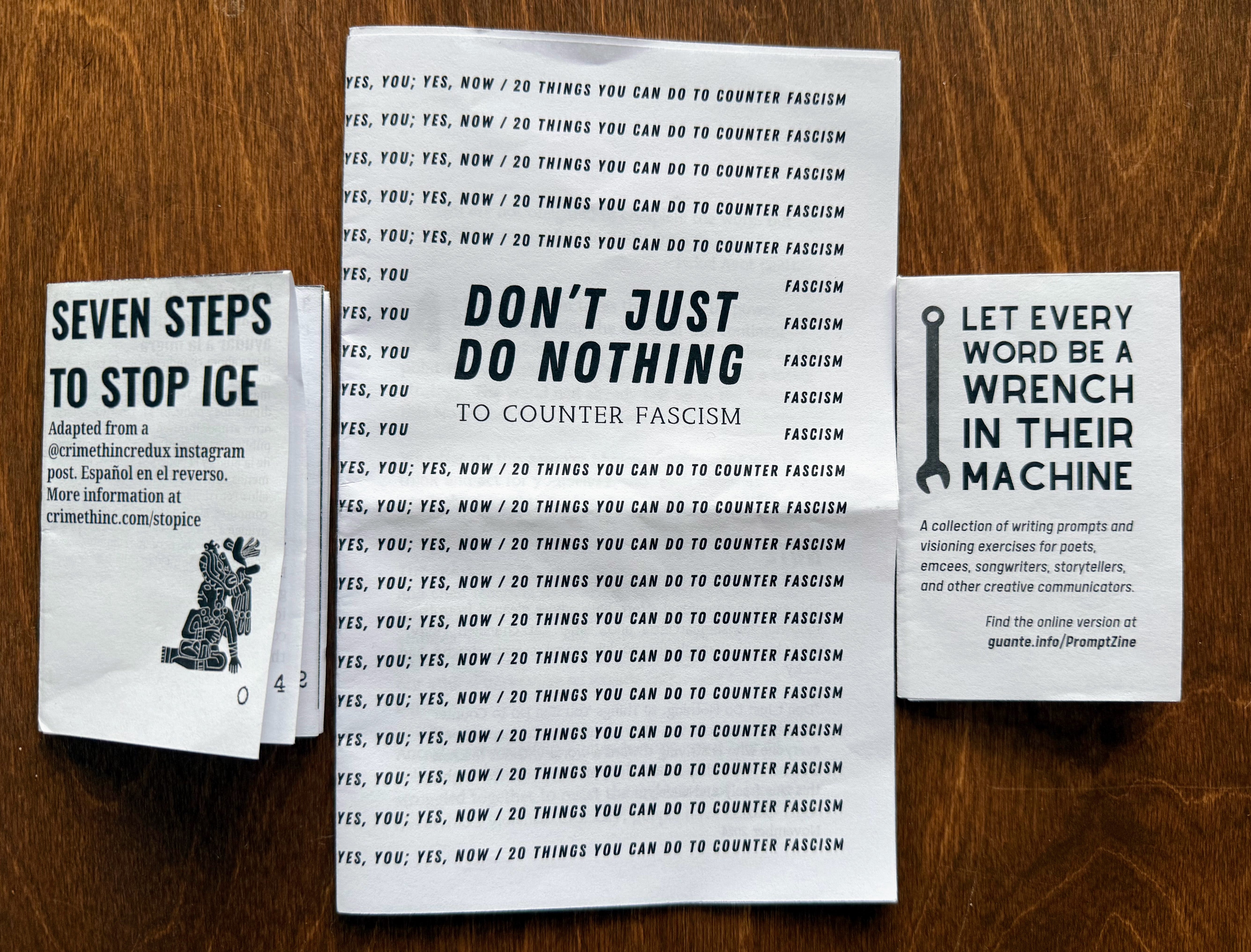
I know that’s what I needed. I was feeling afraid to come home, fearful of all the things my email inbox contained, afraid of the news. But then I happened upon a pile of zines. Someone had dropped them overnight on a community table, and it made me happy to know someone else in this place of peace had also been thinking about the rest of the world, too.
I’m linking a few of those zines and some other resource sheets that I found useful below. I hope you find one you like, print out a bunch of copies and distribute them in your community. Everyone loves zines. There’s a common thread running through all of them: community. By being accountable to other people, and showing up, we avoid hypocrisy and become unbreakable.
Let Every Word Be a Wrench in Their Machine: A Collection of Writing Prompts…
Highlight: “Describe a moment in which you are the ‘wrench in the machine.’ What is the event or situation? How does it feel to disrupt it? What do you say or do?
Highlight: “Create mutual aid networks: support those who have lost family members to ICE abductions. Creative collective habits of care to sustain each other through the crises ahead.”
Thirty lonely but beautiful actions you can take right now which probably won’t magically catalyze a mass movement against Trump but that are still wildly important by Garrett Bucks
Highlight: “Throw the best damn party you can imagine. Make it the party you’d like to attend. … Put the word out so that people who also love that thing find about it. Get to know them. Tell them that the only cost of admission is you want ten minutes to speak about a few ways we can love and resist and build right now.”
Don’t Just Do Nothing to Counter Fascism
Highlight: “Make people soup and do not stop inviting them over for soup! Be a reason for living.”
A List of Actions That Are Not Protesting or Voting
Highlight: “Push back against book bans and the groups that ban books by requesting banned and challenged titles.”
Coupla quick things:
Two podcast interviews this month if you aren’t as sick of my voice as I am: I was on Mission: Implausible to talk with the hosts, both former CIA agents, about conspiracy theories; I was also on the Morbidly Curious Book Club Podcast to talk Blazing Eye Sees All.
If you find yourself in Salem, Oregon next week, come on out to hear me read from Blazing Eye and talk with Professor Seth Cotlar all about extremism: Wednesday, Feb. 4 at 7 pm, Willamette University Law School’s Paulus Lecture Hall
Watch this space — big news dropping soon!!
Have there been other hypocritical eras in American history? Absolutely. Probably more than less.
Let’s be real though: Democrats certainly say lots of things, and also do another.
This Cascade PBS (RIP Cascade PBS) article is a great interrogation of Gibson’s specific hypocrisy.
It should be noted that this seminal moment in Northwestern history happened because of two very, very small details: the debacle over Weaver’s shotgun came down to it being sawed too far by less than a half-inch; Weaver was told the incorrect time for his court appearance.
You’ve read Jess Walter’s book, Ruby Ridge, right? No? It’s so good.
And, of course, if you have listened to Bundyville, you know there is an entire episode about Finicum’s life and role in the occupation. Also, can you believe it’s been 10 years since Malheur? I wrote this piece — “Ten Years Ago, Outlaws Took Over an Oregon Wildlife Refuge” — for Portland Monthly last month.
Is this a real Substack if I haven’t bitched about other media? One thing I’ve been seeing over the last 24 hours is a race to show videos of Pretti yelling at ICE and kicking the tail light of a car. We Portlanders recognize the rush to create a “good protestor/bad protestor” narrative, and this, my friends, is that.
Thanks for this, Leah. That ejaculate line - wow.
I'm always busy building community up here on Whidbey Island ( home to another shoot out back in the day https://en.wikipedia.org/wiki/Robert_Jay_Mathews), but we all need a break. I'm off Sunday to spend a couple of days in a yurt on the Oregon coast getting my own ocean wave fix.
Thanks for all you do. Looking forward to your big news!
It’s hard to get out in January, if you stay busy the days melt away and so I’m inside addicted to every you tube Im On the same page with. As a Buddhist catholic, doesn’t anybody talk about saints anymore we know one when we see or hear about one! For me it’s time to back to church and work with the loving congregation to right this unbelievable wrong and chant to diffuse my anger.