
69. Coloring-book Cops
I went to talk to fourth graders. We ended up talking about cops.

Last week, I woke up much earlier than I’m used to, slammed a cup of coffee and got out the door on time to be a featured guest at a Portland elementary school’s Career Day.
It is not unusual for me to speak to college students and, on rarer occasions, classrooms of spirited teenagers excited about journalism and creative writing. These are bright spots in my career when I’m reminded of where I started — not to mention a needed break from my chosen subjects: extremism, power, belief, violence. As a kid, I was a big reader and writer, and I figure there might be students like me out there in one of these classes who’ll follow their dreams as far as I have.1
Last week was different. It wasn’t until I was standing at the front doors of this school alongside tiny kids with huge backpacks that I realized, wait, I need to explain what I do to fourth graders. I felt a twinge of panic. At the check-in table, I was handed a name tag that read “Investigative Journalist.”
Some Career Day guests have jobs that are inherently cool to kids: an ambulance driver pulled his rig into the playground area, a TriMet driver ferried kids on and off his bus, an arborist talked about how cool trees are and what he does to save them.
Then there was me. I think about democracy all day, kids. Let’s talk about politics, youngsters! Do you want to talk about the First Amendment — no! That is not interesting to kids. Public records requests? Jesus christ, Leah. Suddenly, walking to my assigned classroom, kids ping-ponging all around me, I thought “oh shit, NOTHING I do is interesting to children.”
I became incredibly nervous. Typically when I talk to high schoolers and college students, the presentations don’t require me to do much prep. There is always a contrarian in the room, some little punk who likes the idea that journalism can be a thumb in the eye of society, or some art-kid who, like me, has an unquenchable need to put their thoughts onto a page.
But elementary schoolers? Staring down thirty tiny faces, I realized I had nothing to say.
“Does anyone have any ideas about what a journalist does?”
One precocious child raised their little hand into the air: “journalists write in journals.”
Oh my god, I am so cooked.
“Close! Journals are a type of notepad, and journalist do write in notepads!”
I asked them if they knew what politics were — no they did not. Religion? Nope.
I fumbled forward. Sweat was running down my back. One child put his head on his desk and groaned.
Fuck! Shit! I am absolutely bombing up here.
Out in the playground the ambulance driver turned on his lights and the siren gave a little whoop whoop.
I explained that being a journalist is really fun if you already like to write. I write about real things that happened. I call people on the phone and ask them questions. And then when I’m done talking to that person, I call more people, and ask them about that same topic. And then when I have everybody’s answers, I write an article.
They were listening but I couldn’t tell if I was getting through. I went out on a limb: “do you have pizza day?” I asked. No heads were on desks now.
Yes, we were talking about Thursdays, apparently, when the cafeteria serves little slices of pizza for lunch. “Raise your hands — how many of you like the pizza?” Lots of hands went up.
“OK, who doesn’t like pizza? It’s okay — be honest,” I said. A few hands went up.
Here’s what a journalist does: on Pizza Day, I would talk to all the kids in the cafeteria, and ask them who likes the pizza. Maybe, after talking to everyone, I would find out a lot of kids really don’t like the pizza. And if that happens, then I would go to the principal and say “Kids here don’t like the pizza. Is there a reason it isn’t better?” And I would write an article — and that article might spark a change. Everyone might get better pizza.
My friends, they got it. After explaining it this way, one particular child said being a journalist sounded fun. I said yes! It is so much fun! You get to see behind the scenes of life! If you want to see how a restaurant makes their food, you can ask to go back in the kitchen. If you want to hear your favorite band write a song, you can ask to sit in on band practice.
They started to ask questions.
One kid asked how I figure out where to go talk to the people I put in my stories. I told him usually I find those people in advance, and I call them on the phone, or we email, and we arrange a place to get together.
A few minutes later, he raised his hand again. But what if I go to the wrong place? What do I do then? I wondered if this was an issue for him, being lost. “It’s okay, if you go to the wrong place, you will eventually get to the right place,” I said.
One boy asked if I was married. Personal question, the teacher in the corner piped up. I said yes, I am. More than a few asked if AI was changing my job, and I said I didn’t think so, which is probably a lie, but if I’m being honest I didn’t feel like getting into it.
A kid asked me what my last story was about.
Just days before, The Western Edge had published an investigation that I wrote with my reporting partner, Ryan Haas, called “The Shady Cop Who Haunts Halloweentown: A porn-texting police chief, a mayor posting through it all and the Oregon town that can’t let go of the 2024 election.”
It’s a story about how the city of St Helens, Oregon continues to deal with the chaos stirred up by its disgraced former police chief and the local police union. It’s about the vicious 2024 mayor’s race, and vitriolic fights that continue to plague both City Hall and the discourse in local Facebook groups.
How was I supposed to explain that? I tried my best: I said I wrote about a police officer who was in charge of the police department in a small Oregon city, and how that man wanted more money to buy things for his department, like cars, and a new police station. But the city didn’t have a lot of money to go around, and lots of departments needed it. The library needed money. The parks department needed money. But the policeman wanted a lot more than everyone else, so he told lies to get as much as he could, and he was really mean to people.
The kid furrowed his brow. “Why would a police officer lie?”
Oh my god I’m not going to make it out of here alive.
“Well…”
In that moment, my mind went to a little-known Joan Didion essay from 1968 about this very idea — of police officers behaving in ways that clash with the perceptions some people were brought up to believe were true. Her essay ran in The Saturday Evening Post, in the “Points West” column, and despite people’s absolute freakishness about archiving her work2, it is a bold piece of writing that has not been collected in any of her major anthologies.
Maybe because of the title: it’s called “On Becoming a Cop Hater.”
Recently, University of California at Berkeley professor Scott Saul deconstructed why "On Becoming a Cop Hater" has been lost to time for the magazine Dispatches. He argued that for Didion to maintain her dispassionate image as such a fierce critic of the 1960s counterculture, and to justify her removal from LA to a “house by the sea” that was actually just in Malibu, it would be important for her to omit this kind of work from public memory.
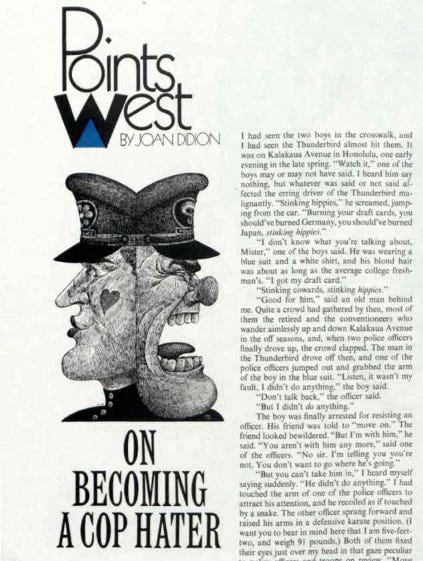
In her piece, Didion tells the story of an afternoon walking down Kalakau Avenue, in Honolulu, when she watched a car almost plow into two young men in a crosswalk. The driver yelled that they were “stinking hippies” who had probably burned their draft cards. The young men yelled back. “I don’t know what you’re talking about,” one said. “I’ve got my draft card.”
A crowd gathered, including Didion, and soon a police car pulled up. The driver pulled away. “I didn’t do anything,” the kid protested to one of the cops.
“Don’t talk back,” the cop said.
Didion watched as the kid’s arms got pulled into cuffs, and the crowd applauded at his arrest over seemingly nothing.
“He didn’t do anything,” Didion said, touching the arm of one of the officers who “recoiled as if touched by a snake.”
The whole scene rattled Didion. She wrote:
I want to tell you a few things about myself. As it happens, I was raised in that stratum of the society which teaches its children that the police are not merely their protectors but, in a world of hostile strangers, perhaps their only friends. When I thought of the police, certain images sprang obediently to mind: Look at the mounted policeman leaning to answer a small boy’s question, then sweeping him onto his saddle for a trot around the park. Watch the patrolman leading the little children across the intersection. Policemen were there to rescue lost balls, and kittens, and, were a child to drop her ice-cream cone, a policeman would dry her tears and buy her another, with a nickel from his own pocket. A policeman was a true friend in blue.
I had never actually come into contact with such a policeman, or in fact with any policeman, but I knew all that to be true because I had seen pictures of it happening, in school readers and in coloring books. So benign was my view of the police that until quite recently, even when I knew myself to be in technical violation of the law, I was confident that the police, should they by some bizarre error apprehend me, would recognize my essential ‘niceness’ — ie., my status as a daughter of the lawful and propertied bourgeoisie — and deliver me to my doorstep with a friendly, and, well, respectful, admonishment.
She spends the rest of her column discussing how witnessing this scene in Honolulu was one of many experiences that shook her coloring-book worldview of police officers.
What I am telling you is that I was nether born a cop hater nor did I become one by way of some dramatic venture into the unlawful; I became one over the course of several years, by way of an accumulation of small encounters, insignificant confrontations. … On the whole the police make it a point to be nice to writers, once they see the press card, but now and then I would meet one who saw writers as just more of the enemy; The enemy, I began to perceive, was anyone not a cop, not on the force, not in the life.
For a long time, as a young writer, I really admired Didion for her cutthroat way of writing about the world. As I’ve aged, my respect for her has fallen away. And while I’m sure she was not alone in this way of thinking about the police — and she should, perhaps, be respected for willingly laying her own ignorance on the table — it shows the gilded life she had led up to that point in Hawaii.
Didion was 33-years-old in the summer of 1968; she held the same view of police officers as children, that they were the savers of kittens and ice cream cones. She was able to live in such ignorant bliss because police did not exist to patrol writers from Malibu.
But I didn’t say any of that to this young, inquisitive mind; Joan Didion is even more boring than me.
How would you explain to a child why a police officer would lie? What do you say so they can understand? I wanted this child to know that his question was a wise one, truly one of the most important questions of our lives, one question with so many answers.
So what I said was: “that’s a really good question. You might want to become a journalist.”
SOME IN-PERSON THINGS —
On April 1, if you find yourself in the neighborhood of Corvallis, Oregon, Oregon State University is hosting a super rad event called “The Making of True Crime: Behind the Scenes,” with me and Mr. Haas. We’ll be in conversation with the professor and brilliant author Justin St. Germain, and Ryan and I plan to talk about some of the behind-the-scenes work that went into Hush. It’s free! Come hang out!
From April 17-19, I’ll be at Unbound Book Festival in Columbia, Missouri, if you can believe it. I have never been to the Show Me State, so please come say hello and tell me good places to eat vegetarian food.
SOME GREAT THINGS I’VE BEEN READING —
Portlanders may recall the dogged work that journalist Sergio Olmos put into covering the 2020 protests here. Now he’s at CalMatters, and put out this really incredible video investigation this week called “Agents of Chaos: Border Patrol’s Year of Unchecked Force.”
Bo Gritz — the man who allegedly inspired the character Rambo, the person who brokered the end of the Ruby Ridge standoff, the creator of many closed “constitutional covenant” communities in the West — died last month, never having responded to the multiple interview requests I sent him over the years. There were many Gritz obits, but I think that David Neiwert wrote on of the best ones, called “The far right's bullshitting heroes: Before there was Trump, there was Bo Gritz.”
My friend and fellow writer James Mapes wrote a fantastic essay that we published over at The Western Edge this week, called “A Life of Observing, or How the Goon Squad Got Me to Quit Smoking.” It’s a beautiful piece about a life in Portland, how protests have intersected with life here for a long time, and the toll it took on Mapes to volunteer as an ACLU of Oregon Legal Observer. Give it your time.
I’M MORE INDEPENDENT THAN EVER (HOORAY/OH GOD)—
I am really, really proud of what we’re doing at The Western Edge, and I have some great stories coming soon from High Country News. But I’m more of a freelance journalist than I have been in a long, long time. It’s never too late to get a paid subscription to this newsletter, or to The Edge, or both!
Freelancing in journalism full-time is incredibly hard right now — there are fewer outlets than ever for me to sell stories to. Doing journalism in this scrappy, DIY way means I have absolutely no one telling me what to do. (That’s how it should be for ALL journalists.) But it is also means I’m doing this work on a razor’s edge. If you agree we need journalism more than ever, and you’ve followed my work over the years, think about a paid subscription? Or, read Hamilton Nolan’s compelling piece on why journalism needs patrons, and think about that.
Last, but not least, it should go without saying, but if you have story ideas or tips, send them my way. Reply to this email, send me a DM, or fill out the contact form on my website.
A story within a story: my freshman year of high school, I was enrolled in an Honors Humanities course, a combination history and English class for eager students like myself. That year, I turned in a short fictional story called “How I Beat the KKK” — I don’t recall what the assignment was.
Somehow over the years I have hung onto six chapters of “How I Beat the KKK.” It looks like I workshopped the piece for several months, and I’m actually kind of impressed by the writing of 14-year-old me.
It’s a story about a group of four boys and one girl who start a club devoted to the Lone Ranger. They have pop guns and they run around in the woods behind their house, but they start stumbling upon the remnants of mysterious fires that have burned in the wilderness. In one scene, the kids confide in a wise shopkeeper, who tells them it’s probably fine but then whispers under his breath “that damn KKK is back,” and the kids then get to wondering: what’s the KKK? They learn, and are very upset, and devote their club to unmasking its leader. In the story’s conclusion, the kids turn that leader into the county sheriff, and it’s a very Scooby-Doo ending.
All my influences were right there on the page: To Kill a Mockingbird, namely. But writing this story was formative: when I wrote it, my teacher called my parents one night on the phone. I wasn’t in trouble, but she wanted my parents to know I could get serious about my writing. I had not, previously, been a student that my teachers paid much attention to. But this was the first, and maybe the only time, a teacher believed in me. That phone call made me see something in myself I would not have otherwise. Anyway, thanks Ms. Milton. You’re the best.
Including her personal journals! Perhaps Didion knew this could happen, and left them behind so she could be studied forever. But for some writers, this is a wonderful reason to go out on a cold afternoon to your backyard firepit with some matches and a warm cup of tea and watch them burn. Which is what I do.
I really enjoyed this, Leah! I smiled and laughed out loud several times. And the ending was so abrupt and perfect. Thanks so much for sharing this career-day experience. What better age to talk with kids about careers?! And it was fun hearing from you about one of your “days in the life of Leah,” and about how you’re more freelance than ever.
I really enjoyed this piece and especially the first footnote. That teacher Ms. Milton is amazing for encouraging your spark of writing into a flame. Please keep doing what you can with your talents!